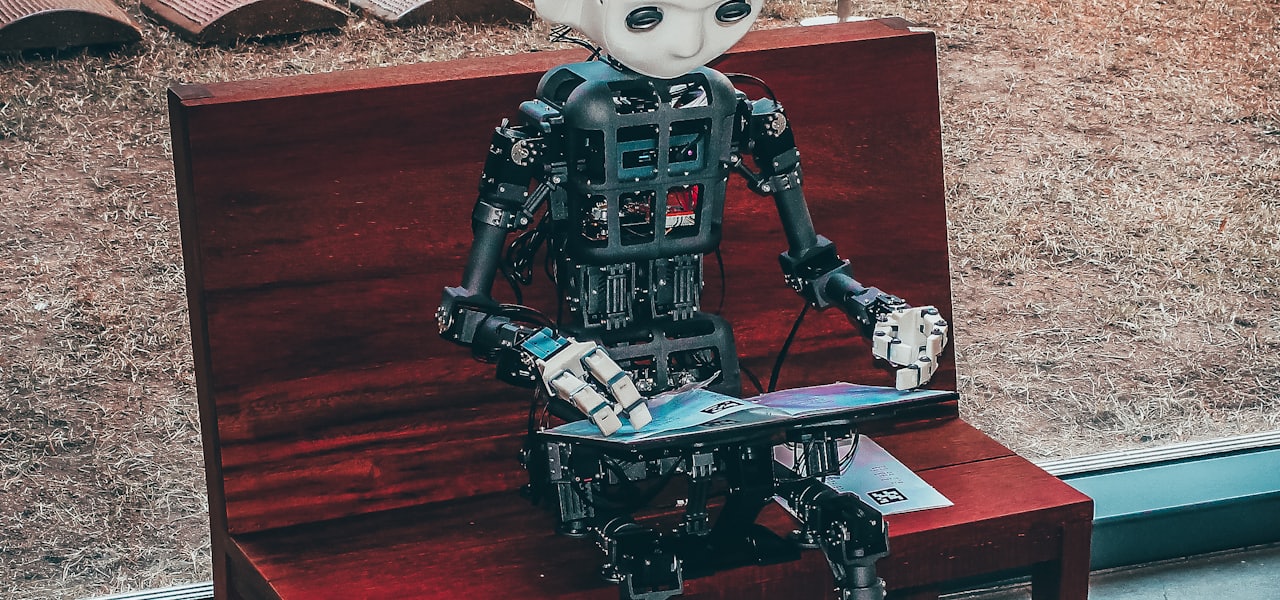
Artificial psychology (AP) has had multiple meanings dating back to 19th century, with recent usage related to artificial intelligence (AI).Artificial psychology is a theoretical field related to artificial intelligence, cognitive science, and psychology, which explores how advanced AI systems may develop human-like decision-making processes. In 1999, Zhiliang Wang and Lun Xie presented a theory of artificial psychology based on artificial intelligence. They analyze human psychology using information science research methods and artificial intelligence research to probe deeper into the human mind. == Main Theory == Dan Curtis (b. 1963) proposed AP is a theoretical discipline. The theory considers the situation when an artificial intelligence approaches the level of complexity where the intelligence meets two conditions: Condition I A: Makes all of its decisions autonomously B: Is capable of making decisions based on information that is New Abstract Incomplete C: The artificial intelligence is capable of reprogramming itself based on the new data, allowing it to evolve. D: And is capable of resolving its own programming conflicts, even in the presence of incomplete data. This means that the intelligence autonomously makes value-based decisions, referring to values that the intelligence has created for itself. Condition II All four criteria are met in situations that are not part of the original operating program When both conditions are met, then, according to this theory, the possibility exists that the intelligence will reach irrational conclusions based on real or created information. At this point, the criteria are met for intervention which will not necessarily be resolved by simple re-coding of processes due to extraordinarily complex nature of the codebase itself; but rather a discussion with the intelligence in a format which more closely resembles classical (human) psychology. If the intelligence cannot be reprogrammed by directly inputting new code, but requires the intelligence to reprogram itself through a process of analysis and decision based on information provided by a human, in order for it to overcome behavior which is inconsistent with the machines purpose or ability to function normally, then artificial psychology is by definition, what is required. The level of complexity that is required before these thresholds are met is currently a subject of extensive debate. The theory of artificial psychology does not address the specifics of what those levels may be, but only that the level is sufficiently complex that the intelligence cannot simply be recoded by a software developer, and therefore dysfunctionality must be addressed through the same processes that humans must go through to address their own dysfunctionalities. Along the same lines, artificial psychology does not address the question of whether or not the intelligence is conscious. As of 2022, the level of artificial intelligence does not approach any threshold where any of the theories or principles of artificial psychology can even be tested, and therefore, artificial psychology remains a largely theoretical discipline. Even at a theoretical level, artificial psychology remains an advanced stage of artificial intelligence.
Pill reminder
A pill reminder is any device that reminds users to take medications. Traditional pill reminders are pill containers with electric timers attached, which can be preset for certain times of the day to set off an alarm. More sophisticated pill reminders can also detect when they have been opened, and therefore when the user is away during the time they were supposed to take their medication, they will be reminded of it when they return. This reminder can be in the form of a light, which also helps for deaf or hearing-impaired users. == Mobile app == A newer type of pill reminder is a mobile app that reminds the owner to take the medication. Some of these applications might effectively support adherence to taking medications.
Fuzzy differential inclusion
Fuzzy differential inclusion is the extension of differential inclusion to fuzzy sets introduced by Lotfi A. Zadeh. x ′ ( t ) ∈ [ f ( t , x ( t ) ) ] α {\displaystyle x'(t)\in [f(t,x(t))]^{\alpha }} with x ( 0 ) ∈ [ x 0 ] α {\displaystyle x(0)\in [x_{0}]^{\alpha }} Suppose f ( t , x ( t ) ) {\displaystyle f(t,x(t))} is a fuzzy valued continuous function on Euclidean space. Then it is the collection of all normal, upper semi-continuous, convex, compactly supported fuzzy subsets of R n {\displaystyle \mathbb {R} ^{n}} . == Second order differential == The second order differential is x ″ ( t ) ∈ [ k x ] α {\displaystyle x''(t)\in [kx]^{\alpha }} where k ∈ [ K ] α {\displaystyle k\in [K]^{\alpha }} , K {\displaystyle K} is trapezoidal fuzzy number ( − 1 , − 1 / 2 , 0 , 1 / 2 ) {\displaystyle (-1,-1/2,0,1/2)} , and x 0 {\displaystyle x_{0}} is a trianglular fuzzy number (-1,0,1). == Applications == Fuzzy differential inclusion (FDI) has applications in Cybernetics Artificial intelligence, Neural network, Medical imaging Robotics Atmospheric dispersion modeling Weather forecasting Cyclone Pattern recognition Population biology
A.I. Insight forums
The Artificial Intelligence Insight forums, also known as the A.I. Insight forums, are a series of forums to build consensus on how the United States Congress should craft A.I. legislation. Organized by Senate Majority Leader Charles "Chuck" Schumer, the first of nine closed-door forums convened on September 13, 2023. == Background == Amid a surge in the popularity and advancement of artificial intelligence, senator Chuck Schumer launched an effort to establish a framework for the regulation of A.I. in April 2023. By the end of June, a preliminary framework – dubbed the "SAFE Innovation Framework" – was established and presented to Congress. Schumer also announced a series of forums wherein tech leaders who were well-acquainted with A.I. would help to "educate" Congress on the risks and problems that A.I. poses. Many tech leaders including Sam Altman, Elon Musk, and Sundar Pichai were set to attend the meetings. Many U.S. lawmakers and senators such as Mike Rounds and Todd Young were also set to attend. == September 13 forum == The overarching consensus following the conclusion of the September 13 forum was that there "should be" regulations regarding the use and advancement of A.I., but it should not be made "too fast". Many tech executives who attended the forum also warned senators of the risks and threats that A.I. could pose. Musk, who attended the forum, stated afterwards that there was "overwhelming consensus" on the regulation of A.I. === Invitees === This is a list of people who were invited to attend the September 13 forum. Elon Musk (Tesla, SpaceX, X Corp.) Sam Altman (OpenAI) Bill Gates (ex–Microsoft) Jensen Huang (Nvidia) Alex Karp (Palantir) Satya Nadella (Microsoft) Arvind Krishna (IBM) Sundar Pichai (Alphabet Inc., Google) Eric Schmidt (ex–Google) Mark Zuckerberg (Meta) Charles Rivkin (Motion Picture Association) Liz Shuler (AFL-CIO) Meredith Stiehm (Writers Guild of America) Randi Weingarten (American Federation of Teachers) Maya Wiley (LCCHR) == October 24 forum == The second of nine forums was hosted on October 24, 2023, as federal A.I. regulation drew nearer. According to Schumer's office, the forum was centered mainly on how A.I. could "enable innovation", and the innovation that is needed for the safe progression of A.I. At the forum, Senators Brian Schatz and John Kennedy introduced the "Schatz-Kennedy A.I. Labeling Act", a new piece of A.I. legislation that would provide "more transparency on A.I.-generated content". Following the forum, Senator Rounds stated that in order to fuel the development of A.I., a total estimated $56 billion would be needed for the next three years. Rounds, alongside Senator Young and Schumer, also highlighted the need to outcompete China and workforce initiatives. === Invitees === 21 people were invited to attend the forum, and were composed largely of venture capitalists, academics, civil rights campaigners, and industry figures. Some key figures included venture capitalists Marc Andreessen and John Doerr. == Future == Over the course of fall 2023, there is slated to be a total of nine forums on the topic of A.I., with the first hosted on September 13.
Flux (text-to-image model)
Flux (also known as FLUX.1 and FLUX.2) is a text-to-image model developed by Black Forest Labs (BFL), based in Freiburg im Breisgau, Germany. Black Forest Labs was founded by former employees of Stability AI. As with other text-to-image models, Flux generates images from natural language descriptions, called prompts. == History == Black Forest Labs (BFL) was founded in 2024 by Robin Rombach, Andreas Blattmann, and Patrick Esser, former employees of Stability AI. All three founders had previously researched the artificial intelligence image generation at LMU Munich as research assistants under Björn Ommer. They published their research results on image generation in 2022, which resulted in creation of Stable Diffusion. Investors in BFL included venture capital firm Andreessen Horowitz, Brendan Iribe, Michael Ovitz, Garry Tan, and Vladlen Koltun. The company received an initial investment of US$31 million. In August 2024, Flux was integrated into the Grok chatbot developed by xAI and made available as part of premium feature on X (formerly Twitter). Grok later switched to its own text-to-image model Aurora in December 2024. On 18 November 2024, Mistral AI announced that its Le Chat chatbot had integrated Flux Pro as its image generation model. On 21 November 2024, BFL announced the release of Flux.1 Tools, a suite of editing tools designed to be used on top of existing Flux models. The tools consisting of Flux.1 Fill for inpainting and outpainting, Flux.1 Depth for control based on extracted depth map of input images and prompts, Flux.1 Canny for control based on extracted canny edges of input images and prompts, and Flux.1 Redux for mixing existing input images and prompts. Each tools are available in both Pro and Dev models. In January 2025, BFL announced a partnership with Nvidia for inclusion of Flux models as foundation models for Nvidia's Blackwell microarchitecture. The company also announced the release of Flux Pro Finetuning API, designed for customisation and fine-tuning of Flux-generated images and a partnership with German media company Hubert Burda Media for usage of Flux Pro as part of content creation. On 29 May 2025, BFL announced Flux.1 Kontext, a suite of models that enable in-context image generation and editing, allowing users to prompt with both text and images. Alongside this, BFL Playground, an interface for testing Flux models was released. On 31 July 2025, BFL announced Flux.1 Krea Dev, a model developed in collaboration with Krea AI that trained to achieve better performance, more varied aesthetics, and better realism compared to existing text-to-image models. In September 2025, Adobe Inc. announced that Photoshop (beta) users can use Flux.1 Kontext Pro as a model for its generative fill tool. BFL collaborated with Meta on Vibes, a video-generation app. On 25 November 2025, BFL announced the release of Flux.2 model series, consisting of Pro, Flex, Dev, and Apache 2.0-licensed Klein (meaning Little or Small in German language) models along with Flux.2 variational autoencoder which also released as open-source software under Apache 2.0 licence. This series claimed improvements for image reference, photorealism, typography, and prompt understanding. == Models == Flux is a series of text-to-image models. The models are based on rectified flow transformer blocks scaled to 12 billion parameters. Flux.1 models were released under different licences with Schnell (meaning Fast or Quick in German language) released as open-source software under Apache License, Dev released as source-available software under a non-commercial licence (users can obtain a self-serving commercial licence for Dev from BFL), and Pro released as proprietary software and only available as API that can be licensed by third-party users. Users retained the ownership of resulting output regardless of models used. An improved flagship model, Flux 1.1 Pro was released on 2 October 2024. Two additional modes were added on 6 November, Ultra which can generate image at four times higher resolution and up to 4 megapixel without affecting generation speed and Raw which can generate hyper-realistic image in the style of candid photography. Flux.1 Kontext is a series with in-context image generation and editing capabilities. It is available in Max, Pro, and Dev models. Max is the highest quality model and can be used to iteratively modify an existing image by using prompt while Pro is optimized to balance quality and speed of generation. Dev is an open-weight model released under non-commercial license, same as Flux.1 Dev. Flux.2 models are based on latent flow matching architecture with Mistral AI's Mistral-3 model (24 billion parameters) for its vision-language model. As with Flux.1, Flux.2 models were also released under different licences with Klein released as open-source software under Apache License, Dev released as source-available software under a non-commercial licence (users can obtain a self-serving commercial licence from BFL), and both Flex and Pro released as proprietary software and only available as API. The models can be used either online or locally by using generative AI user interfaces such as ComfyUI, Recraft Studio and Stable Diffusion WebUI Forge (a fork of Automatic1111 WebUI). Related to Flux is a text-to-video model by Black Forest Labs, under development as of February 2026. == Reception == According to a test performed by Ars Technica, the outputs generated by Flux.1 Dev and Flux.1 Pro are comparable with DALL-E 3 in terms of prompt fidelity, with the photorealism closely matched Midjourney 6 and generated human hands with more consistency over previous models such as Stable Diffusion XL. Flux has been criticised for its very realistic generated images. According to media reports, depictions ranged from an image of Donald Trump posing with guns to disturbing scenes, which triggered discussions about ethical implications of Flux models. After the release of the model, social media platform X was flooded with Flux-generated images. Black Forest Labs has not provided exact details of the data used to train the model. Ars Technica suspected that Flux is based on a large, unauthorised collection of images scraped from the internet, a controversial practice with potential legal consequences. According to a test performed by Japanese technology news website Gigazine for Flux.1 Kontext, the model series has a good understanding of the English language and can easily transfer style of the image from photorealistic into anime-style according to prompts given by the user; however, its ability to understand Japanese is quite poor. == Availability == In addition to the official BFL Playground on its website, the Flux models are also widely available through various third-party platforms for creative and professional use. These include repositories on platforms like Hugging Face and Replicate. == Further readings == FLUX.1 Kontext: Flow Matching for In-Context Image Generation and Editing in Latent Space (29 May 2025) FLUX.2: Analyzing and Enhancing the Latent Space of FLUX – Representation Comparison (25 November 2025)
Autocommit
In the context of data management, autocommit is a mode of operation of a database connection. Each individual database interaction (i.e., each SQL statement) submitted through the database connection in autocommit mode will be executed in its own transaction that is implicitly committed. A SQL statement executed in autocommit mode cannot be rolled back. Autocommit mode incurs per-statement transaction overhead and can often lead to undesirable performance or resource utilization impact on the database. Nonetheless, in systems such as Microsoft SQL Server, as well as connection technologies such as ODBC and Microsoft OLE DB, autocommit mode is the default for all statements that change data, in order to ensure that individual statements will conform to the ACID (atomicity-consistency-isolation-durability) properties of transactions. The alternative to autocommit mode (non-autocommit) means that the SQL client application itself is responsible for ending transactions explicitly via the commit or rollback SQL commands. Non-autocommit mode enables grouping of multiple data manipulation SQL commands into a single atomic transaction. Some DBMS (e.g. MariaDB) force autocommit for every DDL statement, even in non-autocommit mode. In this case, before each DDL statement, previous DML statements in transaction are autocommitted. Each DDL statement is executed in its own new autocommit transaction.
Pulsar (social listening platform)
Pulsar is a software platform for social media monitoring, audience intelligence and social listening that allows organizations to monitor and analyze online conversations across social media, news, and other digital sources. The platform combines social media listening, media monitoring, trend analysis, and audience segmentation to help users understand public discussions and audience behavior in real time. The platform is a social listening platform, which aggregates data from networks such as X, Facebook, Instagram, and forums) and applies artificial intelligence for text and sentiment analysis. Pulsar is offered as a cloud-based Software as a Service (SaaS) tool and insights consultancy. It has been part of Pulsar Group (formerly Access Intelligence), a publicly listed group of communications software products, since 2019. As well as commercial uses, the platform has been used in peer-reviewed academic research analysing online discourse. The platform is listed on the UK government's G-Cloud 14 Digital Marketplace for the provision of social listening and audience intelligence services. == History == Pulsar originated in the early 2010s as a project within Face, a London-based innovation and market research consultancy. The platform's first product, Pulsar TRAC, launched in 2013 as a social media analytics tool. Pulsar TRAC was designed to measure the reach of conversations, mapping brand audiences, and tracking how content spreads through networks. The development was led by Dr Francesco D'Orazio, who created the Pulsar brand and led the development of the platform while serving as VP of Product and Innovation at Face. Face itself had been acquired by the Cello Group Plc (a UK-based advisory firm) in 2012, and Pulsar became part of Cello's portfolio of research and data tools. In January 2017, Cello Group made a significant investment to scale Pulsar and announced the merger of Face's qualitative research business into Pulsar, unifying both under the Pulsar brand for global expansion. In 2018, Pulsar opened an office in Los Angeles to better serve its growing U.S. client base in media, healthcare, and entertainment sectors and Francesco D'Orazio was appointed CEO. The company focused on developing new products amid a wave of consolidation in the social listening industry. In October 2019, Pulsar was acquired by Access Intelligence Plc (now Pulsar Group), an AIM-listed communications software company. The group, which also owns PR and media tools Isentia, Vuelio and ResponseSource, integrated Pulsar to their end-to-end marketing and communications insights offering. Pulsar established a new office in Sydney, Australia in 2022 as part of this global expansion, adding to its existing offices in London and Los Angeles. In 2023, Pulsar Group (then Access Intelligence) was recognised as one of Europe's fastest growing companies by the Financial Times. In May 2024, Access Intelligence PLC changed its name to Pulsar Group PLC. The company has since continued to develop its platform. In March 2025 it introduced new tool Narratives AI, described as a "search engine for public opinion" and the first of its kind for analyzing public narratives and their evolutions in both social media and the news. In October 2025, Pulsar launched Insight Agents, a set of AI agents embedded into the platform advertised to "proactively anticipate user needs or issues, carry out routine tasks, uncover anomalies in your datasets, and prompt responses at scale, 24/7." == Products == Pulsar's architecture integrates four main products into a single interface. The core product suite is often broken into three main components: Pulsar TRAC (for social listening and audience analysis), Pulsar TRENDS (for trend discovery and analysis), and Pulsar CORE (for owned-channel and web analytics). Pulsar's fourth product is Narratives AI. === Pulsar TRAC === Pulsar TRAC is a social listening and audience intelligence platform that allows users to configure searches that track public conversations and measure audience behaviour. Pulsar TRAC is focused on conversation insights and audience segmentations - the platform is reported to collect and analyse data from a wide range of sources, including major social networks, forums, news and review sites, and ecommerce platforms, with real-time visualisations and AI-supported analytics used to find patterns and communities of interest. Pulsar TRAC can be incorporated into workflows with other audience tools, such as an integration with Audiense that connects TRAC's conversation insights to external audience-segmentation datasets. === Pulsar CORE === Pulsar CORE centres on the analysis of owned-channel data, such as brand social media profiles, website interaction and other in-house digital assets, to generate audience and content insights. CORE can monitor published content, evaluate competitors, and extract demographic and behavioural segmentation from owned channels. === Narratives AI === Narratives AI is a tool within the Pulsar audience intelligence platform that uses artificial intelligence to detect, cluster and analyse narratives forming across social and news media. It was launched in March 2025 as a standalone search interface that processes real-time and historical data to find cultural trends, behaviours and beliefs. It uses clustering algorithms and visualisation to show how conversations form and spread online, and their relative importance within wider discourse. == Notable features == === Insight Agents === Pulsar's Insight Agents are AI-powered agents within the Pulsar platform designed to automate and augment common tasks in media, social, audience and narrative intelligence. Branded as TeamMates, these agents are grouped into four functional types: Sentinels for real-time monitoring, anomaly detection and alerting Oracles for forecasting and scenario planning Custodians for governance, compliance and policy enforcement Analysts for research, reporting and recommendations Each agent is trained on Pulsar's multi-source data and domain-specific workflows. In February 2026, Pulsar introduced 'Crisis Oracle,' an AI-driven system designed to quantify narrative momentum and predict reputational risk. == Academic research == Pulsar has been used as a data collection and analysis tool in peer-reviewed academic research across public health, infodemiology, veterinary science, and policy research. Published uses include a World Health Organization report on infodemic management, a Journal of Medical Internet Research study on headache and migraine discourse across Japan, Germany, and France, a Frontiers in Big Data study of Long COVID narratives, and Frontiers in Veterinary Science studies on canine chronic kidney disease and oral medication administration in dogs.